
John was right. And that was the problem.
THE PERCEPTION GAP | OBSERVATIONS
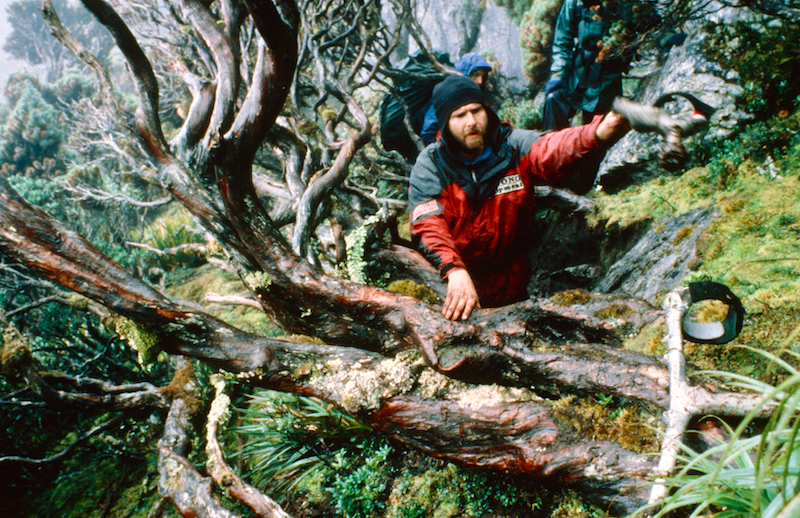
After I climbed Cradle Mountain, a friend suggested we climb Federation Peak.
I thought he was nuts.
Federation Peak sits deep in Tasmania’s Southwest Wilderness. It’s not that high at 1,224m (4,016ft), but it’s the closest we have in Australia to a “real” mountain. Getting there means days of hiking through some of the roughest country in Australia, followed by an exposed climb to the summit.
Federation had intimidated me when I had two legs.
Now Gary is suggesting attempting it without them.
Like I said: nuts...
But the idea wouldn’t go away:
What if I tried this?
What if we did that?
Would that work?
Eventually, I reached the point where I thought there was a chance it was possible.
Not certainty.
A chance.
And that was enough to start planning.
One night I told my manager at the climbing gym, John Willis, what I was thinking.
John had spent years as an outdoor education teacher. He knew Tasmania. He knew Federation Peak. He’d taken groups through that terrain many times.
I expected him to be excited.
Instead, he looked at me and said:
“I think that’s a really bad idea.”
There was a section of the route called the Four Peaks, he explained. Think of the back of a dragon; steep peaks with deep gullies between them.
“You’re not going to get through there in a day,” he told me.
“And there’s nowhere to camp.”
That bothered me.
Firstly, because I thought he'd be excited for me, but more importantly, becaue John knew what he was talking about.
I thought about it for a week or so before eventually deciding: We’re going anyway.
My reasoning was simple.
By the time I reached the Four Peaks, I would have been moving for close to two weeks.
I wouldn’t be the same person who was standing in the climbing gym talking to John.
I would know things I didn’t know yet.
Months later, after training and preparation, we set out.
And eventually, deep in the Eastern Arthur Range, I reached the Four Peaks.
And guess what?
John was right.
Completely right.
There was absolutely nowhere to camp.
But there was something he had never had a reason to look for.
In all the times he had travelled through the Four Peaks, why would he ever have looked for a piece of ground just big enough for a guy who was now three-foot-eleven to lie down?
He wouldn’t.
John had been looking for somewhere to put a tent.
I didn't need somewhere to put a tent.
I needed somewhere to sleep.
Those are two very different problems.
I found a space between the rocks and roots, crawled into my sleeping bag and bivvy sack, and Jez, our photographer, and I spent the night.
The next morning, we kept moving.
A week later, I sat on top of Federation Peak.
For years, I told this story with a takeaway that said:
We can only see what we can see.
I still believe that.
But I think I missed something.
John hadn't failed to see the terrain.
He saw it perfectly.
What he couldn't see was a solution he'd never had a reason to look for.
That's the Perception Gap.
Our experience helps us make sense of the world. But sometimes that same experience defines what we're looking for.
We see the facts.
We recognize the problem.
And without realizing it, we assume we already know what a solution has to look like.
Sometimes the problem isn't that we can't find the answer.
We're looking for the wrong thing.
So here's a question I've been asking myself; you might too:
What am I not looking for because I've never had a reason to look for it before?
Explore The Perception Gap
Discover how Warren's keynote helps audiences navigate uncertainty, see new possibilities and take action.